
There are common misconceptions about alternatives to chlorinated
pools. Many are turning to salt water pools in a belief that it will be
less expensive and lower maintenance. These assumptions are totally
false. If it is sodium hypochlorite pool you desire, you can save
money, many headaches, and a great deal of time by just using bleach.
Bleach is usually 6% sodium hypochlorite.
A saltwater pool is a sodium hypochlorite chlorine pool rather than
calcium hypochlorite pool. The difference is that you make the chlorine
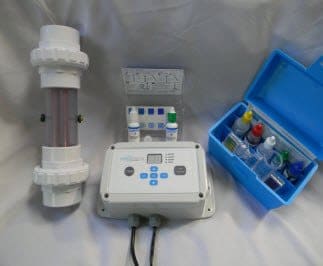
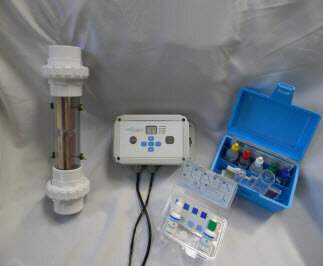
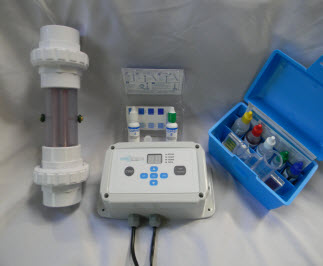
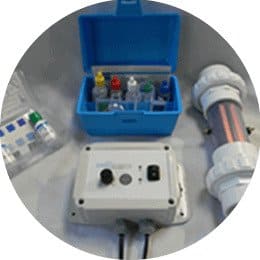
yourself. Technically, a salt water chlorinator works by using
electrolysis to release chlorine gas from the salt in your pool water.
Two to five hundred pounds of salt is added to the pool water to
achieve a saturation of approximately 3200 parts per million. The salt
water is then passed though a chlorinator cell that is electronically
charged and this process releases chlorine gas from the salt. The
chlorine gas then combines with the pool water to create liquid sodium
hypochlorite chlorine.
If you are considering such a salt water chlorinator, there are a few
things you will want to be aware of before you buy. Many pool stores
and builders tend to only mention the pros of these units. You should
know what common problems usually arise and the reason for them so you
can avoid unnecessary disappointment with this new investment.
This list will help you recognize some of the most common problems with salt water chlorinators:
Many
complain about the inability of reaching the desired chlorine level.
This may be caused from the pool pump/filter not running long enough
for the unit to create the needed amount of chorine. The factors that
increase chlorine demand are: heavy bathing load, sunshine, hot
weather, and low stabilizer level.
If the salt level is too low, then the unit will not produce enough chlorine.
If
the stabilizer (Cyanuric Acid) level is too low, the chlorine will not
stay in the pool water long and the unit will not be able to keep up
with demand. This is very common. Many problems occur when the
stabilizer (Cyanuric Acid) levels are too low. 80ppm is recommended by
most manufacturers. In humid climates, as much as 120m ppm may be
necessary to keep the chlorine in the pool. If stabilizer levels are
too low the chorine produced will be burned off by the sun. Conditioner
acts as sunscreen for your chlorine. You may damage the pool's interior
surface with high levels of Cyanuric Acid. High levels of stabilizer
will also cause your skin to itch.
If
salt level is too high, the cell might be failing and thus giving a
faulty salt reading. The cell may indicate to add salt. If this is done
without double checking the true reading, you can over-salt the water.
Most systems will not work if the salinity of the water is too high or
too low.
If
phosphates are present in the water (stain removal products on the
market are loaded with phosphates), they are food for algae. Some may
disagree about these products and say they have no effect. We have seen
this on a regular basis and have the water analyses that tell
otherwise. If phosphate levels are too high, your salt water
chlorinator will act as though it is not creating chlorine. When the
chlorinator creates the chlorine, it immediately has to fight off the
algae that is growing, even when it not visible. When this happens,
your pool cannot catch up and build a reserve of chlorine in the water.
(1-3ppm)
Common Myth 1. One does not have to worry about pH with a salt water chlorinator.
The Truth - When your pH and alkalinity get out of balance, your
chlorine is much less effective. The pH should be 7.4-7.6. Chlorinating
with a salt water chlorinator is similar to chlorinating with liquid
chlorine-- they both have a high pH (11.7). One common problem is that
homeowners tend not to test their pools' pH and alkalinity enough. The
main reason for this is that too many builders and retailers sell these
systems as a "set it and forget it" solution. Most people with salt
systems will run their pH from 7.8-8.0. This is bad for two reasons: 1)
the pool is in a scaling mode, and 2) the chlorine is shrouded by the
basisity of the higher pH. It is best to run between 7.4-7.6 when using
chlorine.
Common Myth #2. Salt water pools are safe on equipment and pool surfaces.
The Truth - The salt itself has issues of attacking the cement in the
plaster and deck materials. This is a relatively slow process as the
salt levels are low. The salt also can kill any landscaping in or
around the pool as well as in the backwash area.
If the sodium hypochlorite levels are too high, the main problem can be
the corrosion by the chlorine being produced by the electrolytic cell.
Chlorine can bleach the reagents, giving you a "false negative", and
people can grossly over-chlorinate their pool damaging equipment, the
pool surface, lighting fixtures, and ladders.
A common problem is corrosion at the ladder. The deck anchors are
usually cast aluminum and the ladder is usually stainless steel. The
saltwater will corroded the anchors overtime.
Everyone should be aware that if you have salt water (in the 2800 ppm
or more range), you should be prepared to seal your coping, especially
if it is porous like limestone. Otherwise, the salt will dry and start
to etch into your coping. Besides sealing the stone, it is also
advisable and an added precaution to hose down the coping at the end of
any swim day with fresh water. Although the salt-water in the pool is
not corrosive at levels of 3000-3500 ppm, when that water hits the
coping and evaporates, it leaves pure salt behind. The pure salt is
corrosive and is probably the cause of the corroding coping.
Some pool builders are now refusing to build any salt water pools with
cream limestone or taupe coping. Any customer that wants either coping
for a SWG pool must usually sign a release form. Pool builders have
said that they have had to replace a significant amount of both these
types of coping this past year.
Common Myth #3. One size fits all.
The Truth - It is very important when buying a chlorinator to oversize
the unit for your pool. You are better off having a chlorinator too
large for your pool than too small. A chlorinator too large can be
turned back or run for less time each day, making the cell last longer.
A unit too small will mean algae problems later on if you don't run it
for longer periods each day or add extra chlorine (no, not salt) on a
regular basis.
Common Myth #4. There is no maintenance on a salt water pool.
The Truth - All salt water generator cells require cleaning. This must
be carried out before the calcium build up within the cell housing
becomes one big block. If left for too long, it will do two things:
Break the cell housing.
Shorten the cell life.
It is also very important to watch your salt level in the pool. A low
salt level (less than 2000 ppm) will cause oxygen production and damage
the platinum group metals on the anode, therefore, shortening the life
of the cell. It is recommended that you try to keep the salt level at
the higher end of the manufacturer's scale for you model. Care must be
taken not to exceed the maximum output of the power pack, as this can
damage the rectifiers and transformer.
As with any pool, one MUST maintain a proper pH. Also Cyanuric Acid
levels must be maintained or the chlorine will quickly dissipate out of
the pool.